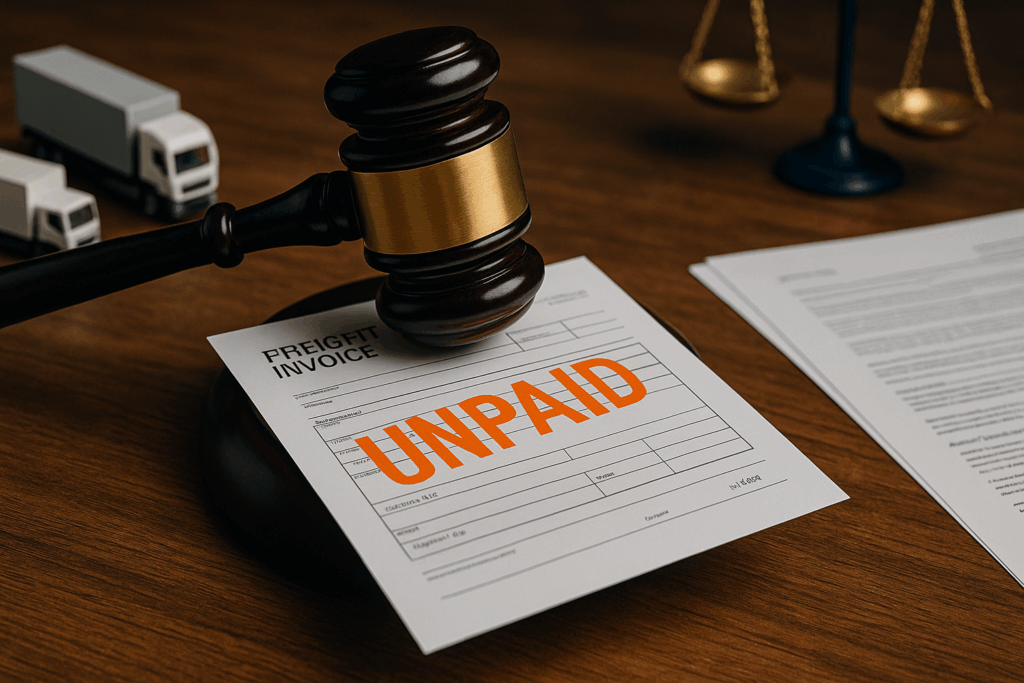
When a broker or shipper delays payment—or refuses to pay at all—it can choke your business’s cash flow and threaten your ability to take on new loads. But going to court isn’t always the best (or first) option. In many cases, there are faster, less expensive ways to resolve the issue and still recover what you’re owed.
This guide breaks down how to use freight contract enforcement tactics outside the courtroom to collect unpaid invoices and enforce payment terms effectively.
Why Non-Payment Happens—and Why You Should Act Quickly
Non-payment under a freight contract often stems from:
- Cash flow issues on the broker or shipper side
- Disputes over delivery, damage, or timing
- Claims of missing paperwork
- Miscommunication or stalling tactics
Whatever the cause, waiting too long reduces your leverage. Acting quickly improves your chances of recovery—especially if you pursue legal remedies that don’t involve costly litigation.
Key Clauses That Strengthen Freight Contract Enforcement
Your first line of defense is the contract itself. When drafted properly, your freight contract should include:
- Clear payment terms (net 15, 30, or 45 days)
- Late payment penalties or interest
- Dispute resolution provisions (mediation or arbitration clauses)
- Attorney’s fees clauses if litigation becomes necessary
If your contract lacks these protections, enforcement becomes harder—but not impossible. You can still rely on general contract law and standard industry practices to support your claim.
How to Enforce Payment Terms Without Filing a Lawsuit
There are three powerful legal tools that don’t require stepping into a courtroom—but still apply pressure and lead to recovery.
1. Send a Formal Demand Letter
A properly written demand letter is often all it takes to prompt payment. It should include:
- Reference to the freight contract and payment terms
- Invoice numbers and total amounts owed
- A deadline for payment (typically 7–14 days)
- Notice of potential legal action or bond claims
This signals your seriousness and creates a paper trail that strengthens your case if further action is needed.
2. File a Bond Claim Against the Broker
All freight brokers in the U.S. must carry a $75,000 surety bond. If you’re a carrier and the broker hasn’t paid, you can file a claim directly with the bond provider.
To do this, you’ll need:
- The broker’s MC number
- Rate confirmation
- Bill of Lading and Proof of Delivery
- Copies of unpaid invoices and communications
This route doesn’t require court, but it does require thorough documentation—and can take several weeks for resolution.
3. Use a Third-Party Collection Service That Understands Freight Law
Some collections companies specialize in freight contract enforcement and operate on contingency (no recovery, no fee). They use proven methods—calls, letters, and negotiation—to resolve the dispute without filing suit.
The key is choosing a firm that understands broker-carrier relationships and the laws that govern them.
Realistic Scenario: Avoiding Court with Strategic Enforcement
Let’s say you’re a carrier who hauled three loads for a California-based broker. You delivered on time, submitted all documentation, but haven’t been paid after 45 days. You don’t want to burn the relationship—but you also can’t afford to wait.
You might:
- Review the broker-carrier agreement to confirm the 30-day payment term
- Send a demand letter with supporting documents
- Notify the broker of your intent to file a bond claim
- Begin the claim process with the FMCSA-listed surety bond
- If no response, hand the matter off to a freight-focused legal collection team
In many cases, this results in payment—without ever setting foot in a courtroom.
When Litigation Becomes Necessary
If all out-of-court options fail, filing a lawsuit may be your only option. This is usually reserved for:
- Large balances owed
- Repeated bad-faith dealings
- No response from the broker or shipper
- Disputes involving fraud or misrepresentation
Litigation is effective—but costly. That’s why freight contract enforcement strategies outside of court should always be your first step.
Conclusion: Use Legal Leverage Before Court Becomes Necessary
Freight contract enforcement doesn’t have to mean filing suit. In many cases, carriers can recover unpaid invoices using letters, bond claims, and strategic pressure. These options save time, protect business relationships, and often lead to faster results.
If you’re tired of waiting to be paid and want a legally sound approach that avoids court, there are proven steps you can take now.
 Ready to Recover Unpaid Freight Invoices Without Going to Court?
Freight Collection Solutions specializes in non-litigation strategies to enforce freight contracts and recover what you’re owed.