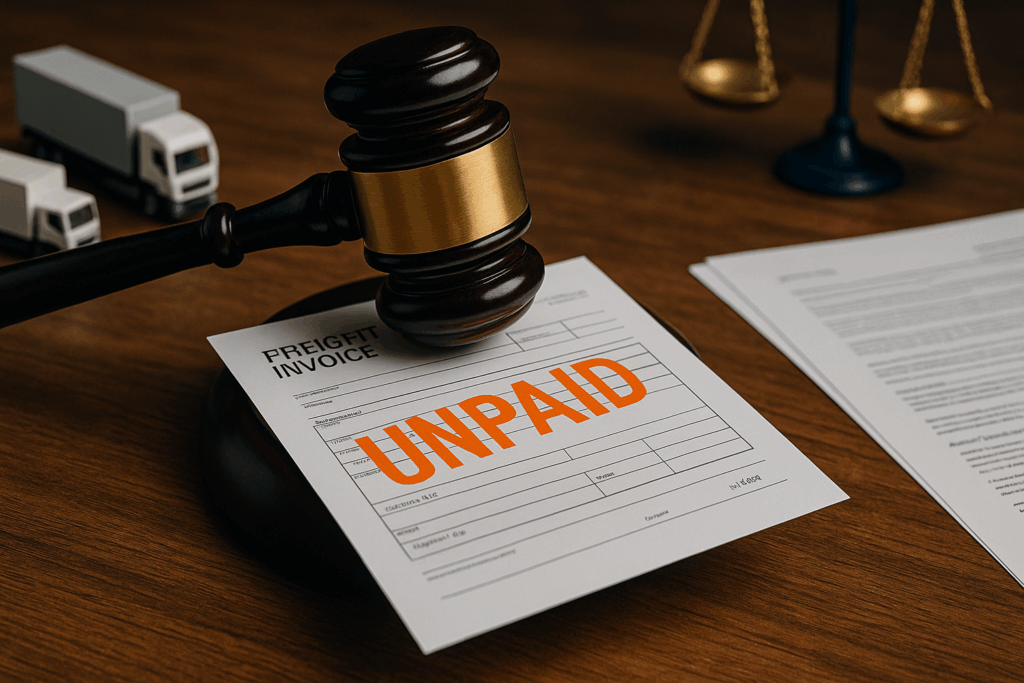
Unpaid freight invoices and broken contract terms can bring your operations to a halt. When a broker or shipper delays, disputes, or outright refuses to pay, you’re left with one critical question: What’s the best way to resolve this—and get paid?
Whether you want to avoid litigation or need to escalate to legal action, understanding your options for freight payment dispute resolution can help you take the right next step at the right time.
When to Treat a Freight Payment Issue as a Legal Dispute
Not every late payment is a lawsuit waiting to happen. But if any of the following apply, it’s time to pursue formal freight contract enforcement:
- Payment is 30+ days overdue
- The broker/shipper is unresponsive or hostile
- You’ve sent multiple follow-ups with no progress
- The amount owed is significant (typically $2,000+)
- You suspect fraud or double brokering
Once the issue rises to this level, choosing the right dispute resolution path becomes critical.
1. Informal Resolution (Best for First-Time Disputes)
Start by attempting direct communication:
- Send a courteous reminder and payment demand
- Resend invoices, PODs, and documentation
- Offer a deadline to respond
Many freight payment disputes resolve quickly when approached calmly and clearly. But if this doesn’t work, it’s time to escalate.
2. Demand Letter (Highly Effective, Low-Cost)
A professionally written demand letter is one of the most powerful tools in freight contract enforcement. It:
- Clearly outlines the amount owed
- Establishes a payment deadline
- Warns of legal action or bond claims
Often, a letter from a lawyer is enough to trigger payment—without litigation. It also builds a legal paper trail if the matter proceeds further.
3. Mediation and Arbitration
If your freight agreement includes an alternative dispute resolution (ADR) clause, you may be required to try mediation or arbitration before filing a lawsuit.
Mediation:
- Involves a neutral third party helping both sides reach agreement
- Non-binding, meaning no one is forced to settle
Arbitration:
- More formal and often binding
- A neutral arbitrator reviews the case and issues a decision
- Generally faster and less expensive than court
ADR is often ideal for preserving business relationships while still seeking resolution.
4. Filing a Broker Bond Claim
If you’re dealing with a non-paying broker, you may be eligible to file a freight broker surety bond claim. This method:
- Doesn’t require a lawsuit
- Is often processed within 30–60 days
- Pays out from the broker’s federally required $75,000 bond
You’ll need solid documentation, including your contract, invoices, and BOLs.
5. Litigation (Last Resort but Highly Effective)
If other resolution methods fail—or the dispute involves serious damages—it may be time to file a freight contract lawsuit.
This route allows you to recover:
- Unpaid invoices
- Legal fees (if allowed in the contract)
- Interest or penalties
- Consequential or reputational damages (in some cases)
An experienced freight contract enforcement attorney can file in the appropriate court and represent you through every step.
How to Choose the Right Path
Your approach depends on:
|
Situation |
Best Resolution Method |
|
New broker, small amount owed |
Informal reminder or demand letter |
|
Broker is stalling or ghosting |
Demand letter + broker bond claim |
|
Contract has ADR clause |
Mediation or arbitration |
|
High dollar amount, no response |
Litigation or dual-track claim |
|
Pattern of non-payment |
Legal action and blacklist/report |
Realistic Scenario: Choosing the Right Dispute Resolution Track
A carrier delivers multiple loads for a broker, totaling $14,000 in unpaid invoices. After two ignored emails, the carrier sends a demand letter, giving 10 days to respond.
No reply. The carrier files a surety bond claim and initiates arbitration per the broker agreement. The case settles in mediation, and the bond provider pays out the remaining balance.
By using multiple dispute resolution tools strategically, the carrier recovers the full amount without stepping into court.
Conclusion: You Have More Legal Power Than You Think
Freight payment disputes are frustrating—but they’re also resolvable. By understanding the full range of freight payment dispute resolution options, you can choose the approach that best protects your business, time, and cash flow.
Whether through negotiation, bond claims, arbitration, or litigation, freight contract enforcement isn’t just possible—it’s often successful with the right tools and legal support.
 Ready to Resolve a Freight Payment Dispute?
Freight Collection Solutions helps carriers and logistics professionals resolve freight contract issues and recover what they’re owed—efficiently and legally.