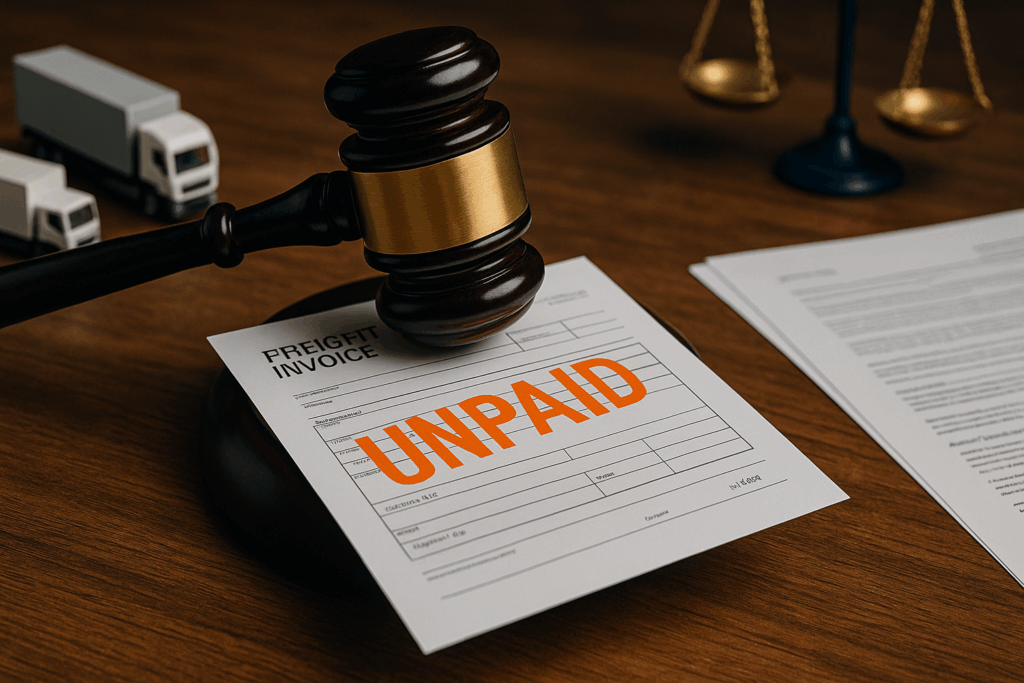
 Still Waiting to Get Paid? Here’s When to Take Legal Action
In the freight world, extended payment terms are common—but that doesn’t mean you should accept not being paid at all. If you’ve exhausted your usual reminders, followed up politely, and still haven’t seen a dime, it may be time to collect unpaid freight invoices using legal means.
This guide explains when legal action becomes necessary, what your options are, and how to go about it. Whether you’re a carrier, broker, or 3PL, you’ll learn how to protect your rights, enforce your contracts, and recover the revenue you earned.
 When Is It Time to Consider Legal Recourse?
Before jumping into court or hiring a lawyer, you need to determine whether legal action is appropriate. Here are five key signs that you’ve entered the unpaid freight invoice recovery zone:
- The invoice is more than 45–60 days past due.
- Your emails, calls, and demand letters have been ignored.
- The broker or shipper has a history of late or missing payments.
- The unpaid invoice is large enough to justify legal costs.
- You suspect double brokering or potential fraud.
If any of these are true, it’s time to start thinking strategically—and legally—about how to collect unpaid freight invoices.
 First: Review Your Documentation
Before taking any legal steps, confirm that your paperwork is complete. Missing or inconsistent records can weaken your case.
You’ll need:
- Rate Confirmation (signed, if possible)
- Bill of Lading (BOL)
- Proof of Delivery (POD)
- Invoice copies
- Email or message records related to the shipment
- Any terms and conditions disclosed before booking
The stronger your paper trail, the stronger your case will be in any freight bill collection services scenario.
 Step 1: Final Demand Letter
Before initiating a lawsuit, most attorneys or collection firms will start with a formal demand letter.
A legal demand letter should:
- Identify the parties involved and the shipment details
- Include copies of documentation
- State the total balance due and payment deadline (7–14 days)
- Warn of legal consequences if ignored
Sending a demand letter on your company’s letterhead is a good start—but a letter from a freight collection attorney is even more persuasive. Many debtors pay once they know legal action is imminent.
 Step 2: File a Claim Against the Broker’s Bond
If a broker is involved and you’re a carrier, you can file a claim against their FMCSA-required surety bond. Every licensed broker must carry a $75,000 bond to ensure carriers get paid.
Here’s how to initiate the process:
- Look up the broker’s MC number and bond provider using the FMCSA SAFER System.
- Contact the bonding company directly.
- Submit a claim with supporting documents (rate confirmation, BOL, POD, and invoice).
Bond claims are an essential tool in freight bill collection services, especially when brokers ghost you or become insolvent.
 Step 3: Small Claims Court
If the unpaid invoice is under a certain threshold (typically $5,000 to $10,000, depending on the state), small claims court may be a good option.
Benefits include:
- No attorney required
- Relatively quick and inexpensive
- You can represent yourself or assign an employee
If you win, the court will issue a judgment in your favor. Keep in mind that a judgment doesn’t guarantee payment—you may still need to enforce it through wage garnishment or asset seizure.
 Step 4: File a Civil Lawsuit
If the invoice exceeds the small claims limit or the situation is more complex (e.g., multiple brokers, cross-border issues, or allegations of fraud), a civil lawsuit may be necessary.
A lawsuit can be based on:
- Breach of contract
- Unjust enrichment
- Fraud or misrepresentation
- Violation of federal regulations
Lawsuits require attorney support, proper venue selection, and formal service of process. If successful, you may recover not only the principal but also legal fees and court costs—depending on your contract terms.
 Step 5: Enforce the Judgment
Winning a lawsuit is just step one. If the debtor still doesn’t pay, you’ll need to enforce the judgment.
Common enforcement tools include:
- Wage garnishment
- Bank account levies
- Liens on business property
- Debtor interrogatories to locate assets
This is where freight bill collection services and attorneys with enforcement experience really shine. They know how to turn paper judgments into real payments.
 Don’t Wait Too Long: Know the Statute of Limitations
Each state limits how long you have to sue over an unpaid freight invoice. This is known as the statute of limitations—and once it expires, you lose your right to sue.
Most states have limits between:
- 2–4 years for breach of written contract
- 3 years for open accounts (e.g., invoices)
To protect your rights:
- Act early—don’t delay collections for “just one more week”
- Keep accurate records of your outreach and deadlines
- Consult legal counsel when in doubt
Every day you wait to collect unpaid freight invoices weakens your position.
What If the Broker or Shipper Goes Bankrupt?
If the debtor files for bankruptcy, recovery becomes much more complicated—but not impossible.
You may:
- File a proof of claim in bankruptcy court
- Join other creditors in seeking a share of the remaining assets
- Recover funds through a broker’s surety bond if still active
In some cases, bankruptcy courts can “claw back” fraudulent transfers or prioritize essential service providers like freight carriers. Working with a legal team experienced in unpaid freight invoice recovery is critical in these situations.
 Legal Recovery vs. Collection Agencies: What’s the Difference?
|
Feature |
Legal Recourse |
Collection Agency |
|
Sends Demand Letter |
|
|
|
Files Bond Claims |
|
Sometimes |
|
Files Lawsuits |
|
|
|
Enforces Judgments |
|
|
|
Negotiates Settlements |
|
|
|
Handles Bankruptcy Claims |
|
|

If polite reminders and collection agencies haven’t worked, legal action gives you teeth. It also sends a message: your business is not one to be ignored.
 FAQs About Legal Freight Invoice Recovery
Do I need an attorney to file in small claims court?
Not always. In most states, small claims courts are designed for individuals and small businesses to represent themselves. But for large sums or complex disputes, legal help is advised.
Can I recover attorney fees if I sue?
Only if your contract or rate confirmation includes a legal fee clause—or if the court awards fees based on bad faith or fraudulent behavior. Without this, each party typically pays its own legal fees.
What’s the average cost to take legal action?
Costs vary widely. A demand letter may cost $100–$300. A lawsuit can range from $1,000–$5,000+. Many freight bill collection services offer contingency-based legal action, meaning they only get paid if you win.
 Ready to Take Action and Get Paid?
You’ve waited long enough. If your freight invoice is overdue and your client is ignoring your calls, it’s time to collect unpaid freight invoices through legal action.
At Freight Collection Solutions, we help trucking companies, freight brokers, and 3PLs enforce their contracts, pursue bond claims, and recover what they’re owed—ethically and efficiently.
Whether it’s a single unpaid invoice or a recurring issue, we’ll build the right strategy for you